
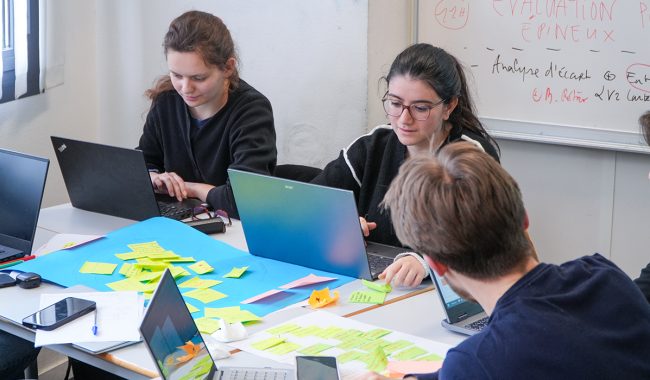
More than 1,700 De Vinci Higher Education students worked simultaneously on a single issue: the possibility of a sustainable city.
Beyond the scale of the initiative, the collaboration between partner schools and the diversity of student profiles, including the participation of international students, form part of a large-scale collective exercise, in which a single issue is addressed at the intersection of management, engineering, and digital technology to compare complementary approaches to concrete urban challenges.
Can a sustainable city really exist? : a hackathon based on a specific academic framework
Over the course of a week, De Vinci Higher Education’s A4 hackathon brought together more than 1,700 French and international students from EMLV, ESILV and IIM classes of 2027 spread across the Paris and Nantes campuses, including 24 students from partner universities (Budapest University of Economics and Business and Karlstad University) and 311 enrolled on the English track, all working on the same topic.
The central question was ‘Can a sustainable city really exist? ’, based on an academic framework defined in advance. The sustainable city is approached as an urban system seeking to reconcile the prudent use of resources, economic attractiveness, quality of life and social inclusion.
Each team selected a European city and developed a practical solution addressing several key themes: mobility, housing, energy, climate adaptation and resource management.
An analytical method: systemic design
The DVHE hackathon uses systemic design as an analytical framework to link an understanding of situations with the development of proposals. This approach goes beyond merely observing symptoms to identify structural causes and underlying patterns.
Teams work to map the interactions between stakeholders, infrastructure and usage patterns, whilst taking into account the indirect effects of their decisions. This analysis enables them to anticipate externalities and identify leverage points likely to bring about measurable change.
The exercise also relies on identifying a gap between current practices and a path towards sustainability. The proposals formulated take into account real constraints and necessary trade-offs, within systems where economic, social and environmental dimensions remain closely intertwined.
Understanding the structural constraints of cities
This hackathon was based on a key observation: cities are home to a significant proportion of economic activity and the population, whilst placing considerable strain on resources and infrastructure.
In Europe, more than three-quarters of the population live in urban areas, with a heavy reliance on transport, housing and service systems. Mobility alone accounts for a significant proportion of energy consumption, particularly through road transport.
Students therefore worked within real-world constraints: limiting the environmental footprint whilst maintaining high service levels, accommodating new residents without expanding urbanised areas, and adapting cities to the effects of climate change.
Projects based on real-world examples
The groups applied these concepts to specific situations. In Lisbon, discussions focused on flood risks and water storage capacity. In Toulouse, the analysis highlighted the dominant role of the car and traffic congestion.
In Rome, proposals focused on improving transport networks to meet the needs of both daily life and tourism. Other teams focused on Oslo, studying existing public policies on sustainable construction and economic incentives.
This work followed the structured approach of the hackathon: identifying a problem, analysing existing solutions, formulating hypotheses and proposing an action plan.
Decision-making at local level: a key issue
The hackathon also incorporated an institutional dimension. The projects took into account the role of local authorities in the practical organisation of cities: urban planning, transport, housing, waste management and energy policy.
There is some local leeway, but this remains constrained by regulatory, financial and economic factors. The trade-offs examined by the teams reflect these tensions: whether to densify or expand, renovate or build, prioritise certain modes of transport or restrict others.
This approach allows moving beyond a theoretical vision of sustainable development and taking into account the real-world conditions of implementation.
A teaching approach based on collective experimentation
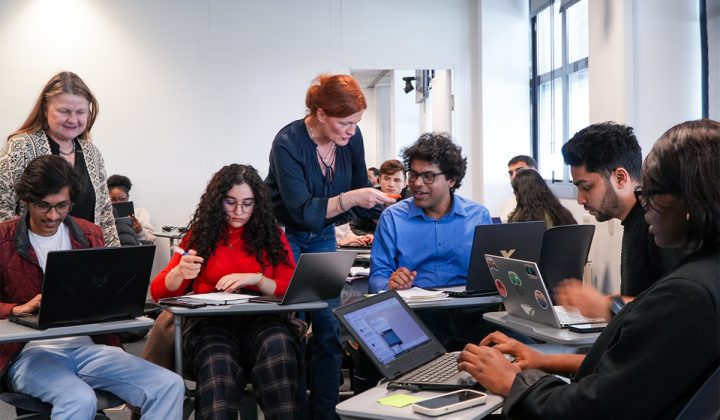
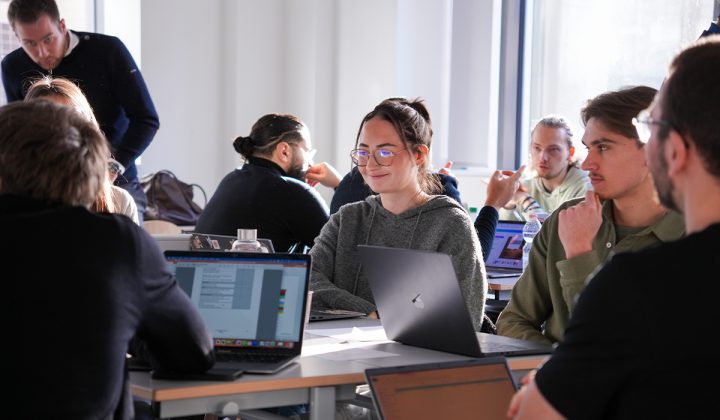
The hackathon format is based on hybrid teams bringing together students from management, engineering and digital backgrounds, including international profiles with diverse cultural backgrounds. Discussions take place in French and English, depending on the composition of the groups.
Students are placed in the role of decision-makers. Working in multidisciplinary and sometimes international teams, they focus their analyses and proposals on European cities and concrete issues: mobility, energy, housing, biodiversity or waste management.
They analyse the interactions between the various dimensions of the urban system, compare viewpoints and construct a reasoned position within a constrained context. At this level, the diversity of profiles acts as an educational lever, making it necessary to clarify disagreements and formulate trade-offs.
The students employ methods such as design thinking, supported by the tutors. The week concludes with a presentation to a jury.
“This format enables us to link theoretical knowledge to a complete project, from identifying the problem to presenting a solution.”
This type of exercise puts into practice the skills expected in global professional environments: analysis, multi-cultural cooperation, decision-making and the ability to formalise a proposal.
An educational approach to training decision-makers for a complex world
The A4 hackathon prepares students to thrive in a VUCA or BANI world, where challenges are complex, volatile and uncertain.
It develops the key skills identified by the World Economic Forum for 2030:
- Systemic and analytical thinking,
- Ability to mediate in conflict situations,
- Leadership and influence,
- Resilience and flexibility in decision-making,
- Collective and behavioural intelligence.
An approach consistent with EMLV’s Master in Management – Grande École Programme
This hackathon reflects the educational approach of EMLV’s Grande École Programme, which leads to a five-year postgraduate qualification, a Master in Management, and is triple-accredited by AACSB, AMBA and EFMD.
Cross-disciplinary projects, exposure to complex issues and interdisciplinary collaboration help to develop graduates capable of addressing economic, technological and environmental challenges.
The question of the possibility of a sustainable city is not limited to a single answer. It opens up a framework for analysis where constraints, public policy choices and operational solutions are brought into play.