
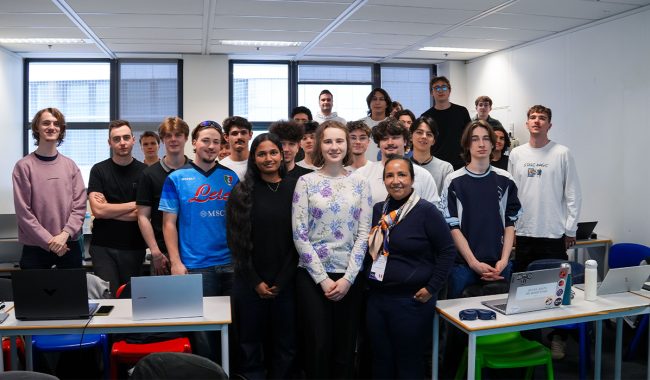
The International Week brings together visiting professors from partner universities to deliver courses in English and expose students to diverse academic approaches. This format prepares future managers for international academic and professional environments.
The International Week reflects the international dimension embedded throughout the Grande Ecole Programme – Master in Management.
An academic format aligned with international exposure
Organised by the International Relations Department of De Vinci Higher Education, the International Week involves students from EMLV, ESILV and IIM. Courses are delivered by professors from partner universities across different regions.
Sessions take place in English, both on campus and online. This structure familiarises students with international academic standards and teaching methods. It also contributes to developing the ability to follow courses in multicultural environments.
Within the Grande Ecole Programme – Master in Management, international exposure is integrated into the curriculum through academic exchanges and professional experience abroad.
Interdisciplinary learning across management, engineering and digital
The International Week is based on a transversal format. Students from management, engineering and digital programmes work together during seminars, workshops and collaborative challenges.
Topics addressed during the week include artificial intelligence, finance, sustainability, entrepreneurship and digital transformation. These themes correspond to the hybrid positioning of the Programme Grande École, combining management, technology and societal understanding.
This interdisciplinary approach reflects the learning environment at the Pôle Léonard de Vinci, where collaboration between different profiles is part of the academic experience.
Visiting professors contributing to sessions followed by EMLV students
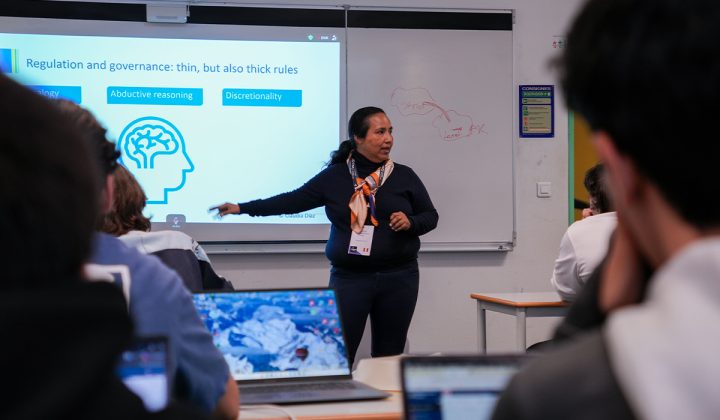
Several visiting professors delivered courses accessible to EMLV students, either within dedicated groups or shared formats with other schools.
- Somdutta Banerjee, Professor of Practice at Woxsen University (India), led a session on AI as a catalyst for social sustainability in STEM entrepreneurship, examining how AI can support socially oriented business models.
- Saloni Sinha, Assistant Professor at Birla Institute of Management Technology (India), taught Whole Brain Thinking and collaborative intelligence, with a focus on cognitive diversity and leadership practices.
- Nimisha Singh, from Bennett University (India), delivered a course on Developing Responsible AI, addressing ethical and operational challenges associated with artificial intelligence.
- Onur Tosun, Associate Professor at Cardiff Business School (United Kingdom), presented on International Finance, covering global markets, financial systems, and instruments.
- Jun Xiao, Assistant Professor at Jönköping International Business School (Sweden), focuses on Organisation Theory, Strategy, and Sustainable Entrepreneurship, linking strategic decision-making to sustainability challenges.
- Julija Skatulaite, an Associate Professor at Vilnius University (Lithuania), delivered a course on Project and Program Management that addressed governance and industry practices.
- Iulia-Cristina Stanica, Associate Professor at the National University of Science and Technology Politehnica Bucharest (Romania), explored Artificial Intelligence applications in healthcare, combining innovation with ethical considerations.
- Ashley A. Stewart, Senior Lecturer at the University of Port Harcourt (Nigeria), taught Digital Design, Management, and Data and AI Ethics, analysing the role of design in responsible digital systems.
- Silvana Tokic, Professor at the University of Split (Croatia), delivered a session on cultural mapping and intercultural communication, focusing on cultural awareness in international contexts.
- Andrew Simoncelli, an Associate Professor at Nicholls State University (United States), presented “Visual Communication in the Age of Artificial Intelligence,” addressing transformations in media and design practices.
- Mônica Rocha de Carvalho, Associate Professor at Fundação Dom Cabral (Brazil), led a course on Governance, Climate Risk, and Sustainability, linking ESG frameworks to corporate strategy.
- Christian Locher, Professor at THI Business School (Germany), focuses on FinTech and financial inclusion, examining digital transformation in banking.
- Jerry O’Connell, Senior Lecturer at Dorset College Dublin (Ireland), delivered a course on Corporate governance, ethics and sustainability in global markets, combining finance, ethics and international business.
- Thomas Petzold, Professor at the Media University of Applied Sciences (Germany), presented on Entrepreneurship in networked ecosystems, focusing on innovation dynamics and professional networks.
Preparing for international mobility
The International Week helps prepare students for academic mobility. Within the Programme Grande École, all students complete an international experience that combines study and professional exposure.
This format supports the development of key competencies: adapting to English-speaking environments, understanding different teaching methods and interacting with international peers.
The international strategy of the EMLV relies on a network of more than 150 partner universities and structured mobility pathways.
An integrated component of the Programme Grande École
The International Week is part of a broader educational framework that combines international exposure, interdisciplinary learning, and hybrid skills development.
Within the Programme Grande École, this approach prepares graduates to evolve in multicultural and technologically driven environments, combining management knowledge with an understanding of digital and societal transformations .
A lire ensuite :
 Promoting Sustainable and Ethical Sports: A Cross-Disciplinary Hackathon at EMLV
 Swarmz Challenge 2025: A Top 5 Finish for ESILV-EMLV Cross-Disciplinary Team
 East China University of Science and Technology: an academic agreement for international mobility at EMLV
 EMLV MBA Experience: Shubham’s, class of 2025, Path to Global Leadership