
At the De Vinci Research Center, a seminar on publication strategies highlights the role of interpersonal skills in scientific output. This approach echoes the supply chain teaching developed within the Grande École Programme.
Beyond academic methods, research also relies on human dynamics that directly influence the quality of collaborations and publications.
A research approach centred on human interactions
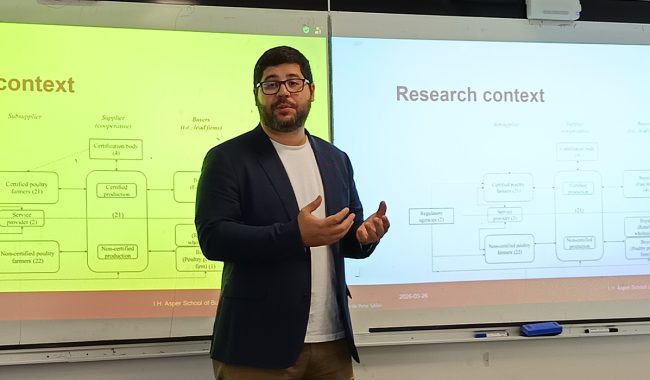
The De Vinci Research Center welcomed Professor Minelle Silva, who teaches Supply Chain Sustainability at the University of Manitoba (Canada), as part of a seminar focusing on publication strategies and career paths in sustainability management.
The presentation offers a perspective that complements traditional approaches. Whilst academic seminars often focus on the choice of methods or fields of study, this presentation highlights the relational dimension of research.
Establishing connections at conferences, building long-term collaborations and maintaining a scientific network appear to be key factors in the development of research projects. This presentation highlights a reality: scientific output relies as much on technical skills as on the ability to interact and collaborate.
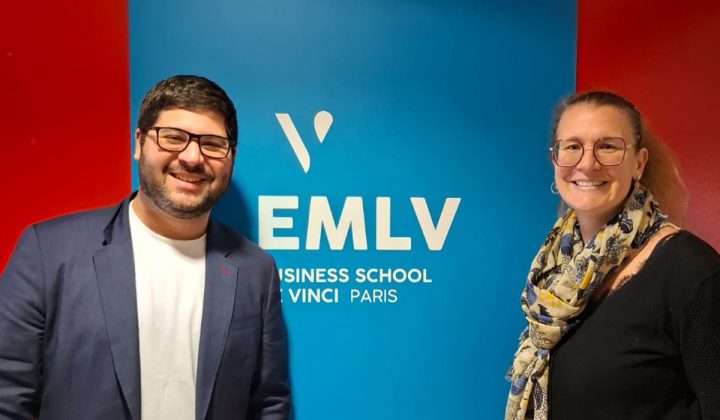
Minelle Silva and Salomée Ruel, Professor-Researcher in Supply Chain Management at EMLV
Transversal skills in the service of scientific output
The discussions held during this seminar demonstrate that soft skills play a central role in academic careers. Communication, active listening and the ability to collaborate with colleagues from different countries or disciplines are key to shaping contemporary research dynamics.
This aspect is part of a broader evolution within the academic world. Publications increasingly rely on international networks, collective projects and multi-institutional collaborations.
In this context, the ability to build lasting relationships becomes a key factor in accessing new fields of study, combining methodological approaches and enhancing the dissemination of scientific work.
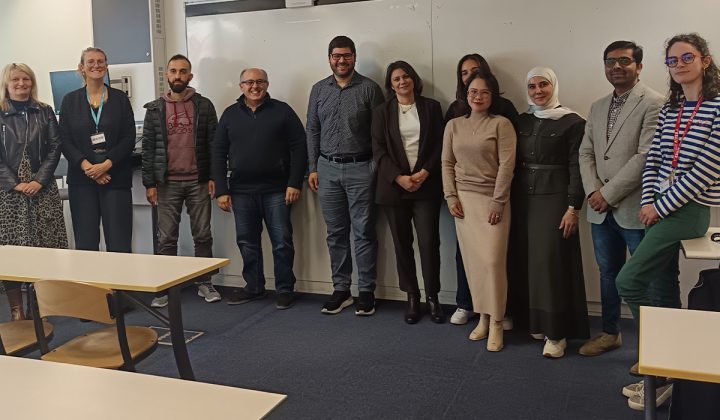
An international academic dynamic within the EMLV faculty
Hosting visiting professors is part of a broader academic development strategy at EMLV. The school’s faculty is characterised by a strong international dimension, with the majority of professors and researchers having international academic backgrounds.
These exchanges create opportunities to compare practices, broaden research perspectives, and accelerate scientific collaborations. They also help strengthen the school’s academic visibility on an international level.
Research seminars are therefore integrated into a pedagogical approach that connects scientific production, teaching, and the understanding of economic and societal transformations.
A seminar aligned with Supply Chain Management teaching at EMLV
The topics covered during the seminar are directly relevant to the supply chain programmes offered at EMLV.
Procurement & Supply Chain Management
The Procurement & Supply Chain Management specialisation within the Master in Management – Grande École Programme addresses the sector’s contemporary challenges: process digitalisation, risk management, operational performance and the integration of environmental considerations.
Students work on issues such as supply chain traceability, supplier management and sustainable supply chains.
MSc in Supply Chain Management
At the same time, the MSc in Supply Chain Management explores these approaches in greater depth in an international context, in light of the global transformations underway in supply chains.
In these programmes, interpersonal skills play a central role. Coordination between stakeholders, negotiation, the management of complex projects and intercultural collaboration are at the heart of professional practice in supply chain management.
Soft skills, research and teaching: a pedagogical coherence
This seminar highlights the coherence between research and teaching. Soft skills are not solely a matter of students’ personal development; they also play a role in generating knowledge.
EMLV is therefore developing a model that combines technical skills, an understanding of global issues and interpersonal skills.
This approach meets the expectations of businesses, particularly in fields such as supply chain management, where stakeholder interactions are constant.
About Minelle Silva
Minelle Silva is a professor of Supply Chain Sustainability at the Asper School of Business (University of Manitoba). His research focuses on supply chain sustainability, responsible procurement, and issues of equity and inclusion.
His research is published in international academic journals such as the Journal of Operations Management, Business Strategy, and the Environment. She is also involved in the work of the European Operations Management Association.