
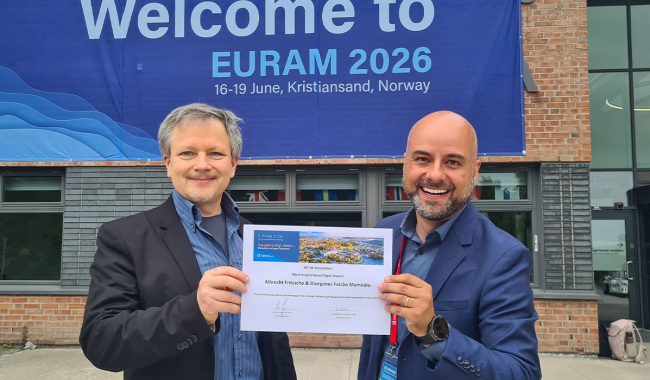
A paper co-authored by Diórgenes Mamédio, Associate Professor of Strategic Management at EMLV, in collaboration with Albrecht Fritzsche, Research Director at IEDC, Bled School of Management (Slovenia), received the Most Inspirational Paper Award from the Innovation Strategic Interest Group (SIG) at EURAM 2026. The research examines how organisations navigate situations where established knowledge and existing frameworks are no longer sufficient.
The European Academy of Management (EURAM) annual conference brings together researchers from around the world to discuss major transformations affecting organisations, management practices and society. The 2026 edition, hosted by the University of Agder in Kristiansand, Norway, focused on the central theme of Navigating High Waters: Managing in an Age of Disruption.
Research on how organisations engage with the unknown
The award-winning paper, Towards an Improvisational Epistemology of the Unknown: Building upon Design Theory and Organisational Improvisation, investigates how organisations can create knowledge and act in situations that cannot be fully understood through existing frameworks or established assumptions.
The research builds on design theory, which considers the unknown as a fundamental dimension of innovation and problem-solving. While organisations often rely on existing knowledge to evaluate situations and make decisions, managers increasingly face contexts where available information is incomplete, and outcomes remain uncertain.
The paper examines how organisations engage with these unknown situations without relying solely on prediction or speculation. Drawing on the field of organisational improvisation, Diórgenes Mamédio develops a conceptual framework explaining how adaptive and situated responses can extend knowledge beyond what is already known.
Rather than extrapolating from existing practices, improvisation enables managers and organisations to respond in real time to emerging situations, generating new possibilities for action while remaining grounded in experience and context. The study argues that improvisation can serve as an epistemic strategy for navigating indeterminacy and supporting innovation in uncertain environments.
The distinction awarded by the EURAM Innovation SIG recognises the contribution of this research to ongoing discussions about innovation, learning and organisational adaptation.
Managing in an age of disruption
The theme of EURAM 2026 reflected the challenges facing organisations across industries. According to the conference organisers, geopolitical tensions, demographic shifts, technological breakthroughs, regulatory complexity and increasing interdependencies are reshaping the environment in which organisations operate.
The conference highlighted several forms of disruption affecting contemporary management:
- Strategic disruption is linked to changes in markets, technologies and business models.
Marketing disruption is transforming customer interactions, products and communication channels. - Supply chain disruption is affecting the flow of goods and services.
- Human resource disruption resulting from technological and societal changes that redefine skills and professional roles.
The questions explored in the Awarded research directly connect with these challenges. Understanding how organisations can act when established models provide only partial answers has become increasingly relevant as companies navigate technological transitions, evolving business models, and rapidly changing market conditions.
EURAM, a leading international academic community
EURAM is one of Europe’s largest academic associations dedicated to management and organisation studies. Its annual conference gathers researchers, doctoral candidates and practitioners from a wide range of disciplines and countries.
The event promotes knowledge exchange, collaboration and the development of responsible research. Through paper presentations, mentoring sessions, doctoral colloquia and networking activities, participants contribute to advancing management scholarship while addressing contemporary economic and societal issues.
The conference also provides opportunities for emerging researchers to present their work, receive feedback from internationally recognised scholars and compete for awards that recognise academic excellence, originality and societal relevance.
Research and knowledge creation at EMLV
Research plays a central role in EMLV’s academic model. As part of De Vinci Higher Education, the school develops expertise in management, innovation, digital transformation, sustainability and the future of work.
These themes align with the Programme Grande École’s (master’s in management) objective of preparing managers capable of understanding technological, organisational and societal transformations. Through their research activities, EMLV faculty contribute to international academic debates while enriching teaching with insights drawn from contemporary management challenges.
The recognition received by Diórgenes Mamédio at EURAM 2026 highlights the contribution of EMLV researchers to the study of how organisations innovate, learn and adapt in environments characterised by uncertainty and change.
Learn more about EMLV’s research strategie
A lire ensuite :
 EMLV’s teacher researcher Ranjan Chaudhuri among the Basant Kumar Birla Distinguished Research Scholar Award 2022 winners
 How social intrapreneurs use serious games to generate social innovation? A research paper by Insaf Khelladi, Associate Professor at EMLV
 Different IT Projects, but the same Conflicts. Action Research During IT Deployment: A paper by Peter Saba
 EuroMed Academy: EMLV’s DBA Faculty Recognised with Ranjan Chaudhuri’s Fellowship