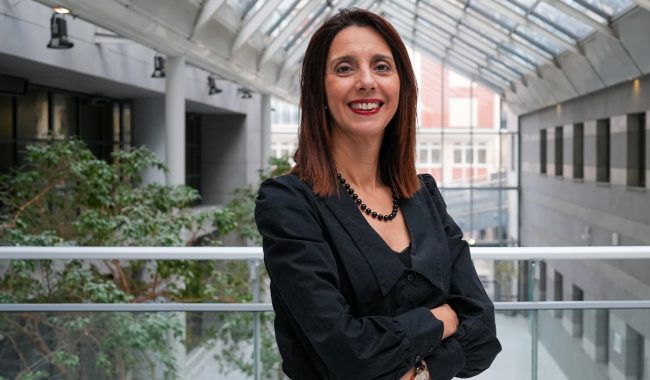
In an interview with Studyrama, Valérie Fernandes, Dean of EMLV, outlined the school’s key areas of development. New campuses, European expansion, artificial intelligence and the evolution of skills form the roadmap for the Master in Management – Grande École Programme, designed to support the transformations taking place in the professional world.
EMLV is continuing its development by building on the core principles that characterise its Grande École Programme, which leads to a Master in Management after five years of higher education: the integration of management, engineering and digital technology, an international outlook, and a teaching approach designed to prepare students for changes in the workplace. During her interview with Studyrama, Valérie Fernandes outlined the strategic directions that will guide this new phase in the school’s development.
Two new campuses to support EMLV’s growth
The start of the 2026 academic year marks a significant development with the opening of two new campuses. In Paris La Défense, EMLV is joining the Campus du Parc, a new 18,000 m² complex situated in the immediate vicinity of the other De Vinci Higher Education sites.
This campus has been designed to foster collaborative teaching methods, interdisciplinary projects and student societies, with flexible workspaces and digital facilities tailored to new ways of working.
At the same time, EMLV is also opening a campus in Montpellier, within CastelMed, thereby strengthening its multi-campus model, which is already established in Paris and Nantes. This new location broadens the opportunities available to students whilst retaining the distinctive features of the Grande École Programme.
A hybrid approach that shapes the educational model
From the very beginning, this hybrid approach has been one of the hallmarks of De Vinci Higher Education. Established simultaneously in 1995, EMLV, ESILV and IIM enable students to work together throughout their studies on projects where management, engineering and digital creation complement one another.
This structure meets the needs of businesses seeking managers capable of engaging with technical specialists, understanding technological challenges and making decisions that take economic, human and societal factors into account.
Within the Grande École Programme, this interdisciplinary approach takes the form of shared modules, inter-school projects, hackathons and specialisations that combine professional skills with technological developments and environmental challenges.
Beyond Boundaries: a strategic platform focused on major transitions
The new strategic platform, entitled Beyond Boundaries, is based on a simple idea: the traditional boundaries between disciplines, regions and learning methods are becoming increasingly out of step with the realities of the workplace.
It is structured around four complementary dimensions:
- transcending disciplinary boundaries through the blending of skills;
- bringing together academic teaching, professional experience and new immersive teaching methods;
- strengthening European and international outreach;
- developing critical thinking in an environment where information is abundant and where decision-support tools are playing an increasingly important role.
This approach keeps pace with changes in the workplace whilst maintaining a central objective: to prepare students for practical management roles in sectors as varied as finance, marketing, human resources, supply chain management and information systems.
A new European dimension
International engagement is already a cornerstone of the Grande École Programme, with the third year entirely devoted to academic mobility and professional experience abroad. Each student therefore spends a semester studying at one of more than 150 partner universities, followed by an international work placement.
This strategy takes a further step forward with the opening of two associated campuses in Madrid and Berlin, developed in collaboration with AD Education. Further European locations are also under consideration.
This presence strengthens the European dimension of the degree programmes and complements an international network that is already deeply integrated into EMLV’s courses.
Training managers capable of working with artificial intelligence
Artificial intelligence is one of the key drivers of change in management roles.
Drawing in particular on projections from the World Economic Forum, which estimates that 39 per cent of jobs will change by 2030, EMLV is gradually integrating AI into all its courses in order to prepare students for organisational transformations.
The aim goes beyond simply learning how to use generative tools. The courses also cover AI systems capable of assisting decision-making, whilst developing the essential skills needed to maintain a critical perspective on the results produced.
This approach is fully in line with the philosophy of the Grande École Programme, where technological skills are systematically combined with human, ethical and managerial dimensions.
The skills expected of future managers
Beyond the knowledge specific to management roles, Valérie Fernandes identifies five skills that will become increasingly important in the coming years:
- the ability to work in hybrid environments;
- critical thinking;
- interpersonal and situational intelligence;
- a sense of responsibility;
- adaptability.
These skills are developed throughout the course of study through teaching, international experiences, interdisciplinary projects, involvement in student societies, sport and work placements, all of which form key elements of the Grande École Programme.
Employability built on a variety of experiences
EMLV prepares students for careers across all major management functions. Students gradually develop their career plans through work placements, work-study programmes, career specialisations, international exchanges and numerous projects carried out with partner companies.
This progression enables students to refine their career choices throughout their studies and to gain professional experience in a variety of settings, both in France and internationally.
More about the Master in Management – Grande Ecole Programme and its available specialisations