
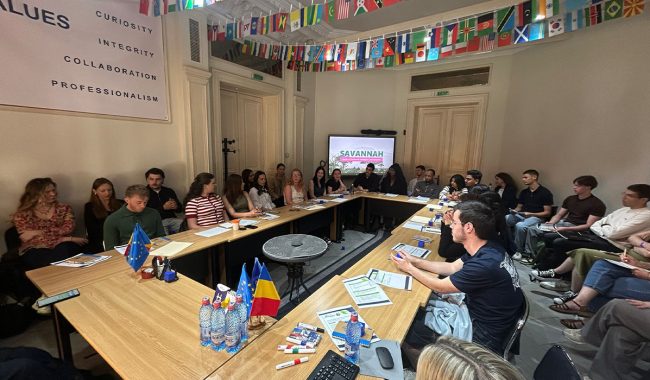
Through a Blended Intensive Programme (BIP) hosted by the Bucharest University of Economic Studies, EMLV students specialising in International Business explored the impact of geopolitical instability on global trade and business strategy. Combining virtual learning and on-site activities, the programme provided a European perspective on resilience in international business.
Understanding geopolitical developments has become an essential component of international management. Trade relations, supply chains, regulatory frameworks and economic partnerships are increasingly influenced by political and geopolitical events, requiring future managers to navigate a more complex environment.
In this context, organised by Muhammad Atif, Associate Professor and Head of International Business programme, a group of EMLV students participated in the Blended Intensive Programme (BIP), Navigating Geopolitical Turbulence: Resilient Strategies for International Trade and Business – Insights from Eastern Europe, hosted by the Bucharest University of Economic Studies (ASE) in Romania.
A programme focused on business resilience in uncertain environments
The programme explored how organisations adapt their international operations in periods of geopolitical uncertainty. Through academic discussions, practical workshops and field visits, participants examined the challenges faced by companies operating in changing economic and political contexts.
Eastern Europe provided a particularly relevant setting for these discussions. Positioned at the crossroads of European and global trade routes, the region offered concrete examples of how businesses, governments and institutions respond to geopolitical disruptions.
The programme encouraged students to analyse international business environments, evaluate risks and identify strategies that support long-term resilience.
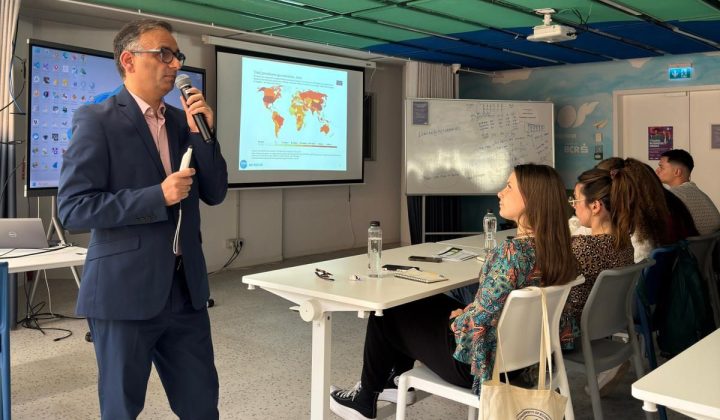
Organised by Muhammad Atif, Associate Professor and Head of International Business programme, EMLV students participated in the Blended Intensive Programme BIP Navigating Geopolitical Turbulence
Combining virtual learning and international mobility
As part of the Erasmus+ framework, the Blended Intensive Programme combined online collaboration with a short-term international mobility experience.
Before travelling to Romania, participants attended virtual seminars that introduced the programme’s key themes and prepared them for the collaborative work that followed during the on-site phase.
The six-day programme in Bucharest brought together students and faculty members from several European institutions. Working in international teams, participants exchanged perspectives on international trade, business development and geopolitical risk management.
Successful completion of the programme enabled students to earn 5 ECTS credits.
Direct exposure to institutions shaping international relations
A key component of the programme was its combination of academic content and institutional visits.
Participants attended advanced workshops and expert sessions dedicated to international business strategy, geopolitical analysis and economic resilience. Team projects challenged students to apply these concepts to practical business situations.
The programme also included visits to several major institutions and strategic sites, including the Romanian Parliament, the Ministry of Foreign Affairs and the Port of Constanța, one of the largest logistics hubs on the Black Sea.
These visits provided insight into the relationship between public policy, international relations and economic activity. Students were able to observe how geopolitical developments influence trade flows, infrastructure and business decision-making.

Erasmus+ & BIP: A combination of academic content and institutional visits
International collaboration at the heart of the experience
Throughout the week, students worked in multicultural teams on projects related to international trade and business strategy.
The final presentations and peer-evaluation sessions encouraged participants to compare approaches, exchange ideas and develop collaborative solutions to complex challenges.
Beyond the academic dimension, the programme also included networking and cultural activities. A city treasure hunt and a gala dinner offered participants opportunities to interact outside the classroom and strengthen connections with peers from across Europe.
These exchanges reflected the realities of contemporary international business, where collaboration across cultures and borders has become a central professional skill.
Master in Management: experiences as part of the EMLV learning journey
International mobility forms an integral part of the Master in Management EMLV Programme. Through academic exchanges, international internships and partnerships with more than 150 universities worldwide, students regularly engage with diverse economic, cultural and professional environments.
The BIP in Bucharest complemented this international approach by focusing on one of the defining challenges facing organizations today: operating successfully in an environment shaped by geopolitical uncertainty.
By combining management education, international collaboration and direct interaction with institutional and economic stakeholders, the programme enabled participants to deepen their understanding of international business and the factors influencing global trade.