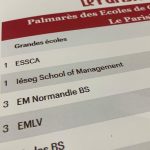


In the 2026 ranking of business schools published by Le Point, EMLV is tied for third place among schools that recruit after the baccalaureate. EMLV’s Grande École Programme, which leads to a Master in Management and is accredited by AACSB, EFMD Master, and AMBA, is tied for 17th place in the overall ranking.
This year, 37 management schools participated in the survey. The ranking distinguishes between master’s degrees recognised by the Ministry of Higher Education and Research.
In the 2026 rankings published by Le Point, EMLV confirms its position among post-baccalaureate Grande École programmes by tying for third place. A segmented reading of the rankings highlights a tie for first place in pedagogy among post-baccalaureate PGE programmes.
Rankings are a useful analytical tool for situating an institution in its environment: EMLV stands out in particular for its pedagogical approach, which is directly structured around technological transformations and new working environments.
Le Point 2026 ranking of Business Schools
1 – Iéseg
2 – Essca
3 – ex aequo – EMLV
3 – ex aequo – EM Normandie
3 – ex aequo – Excelia
6 – PSB
7 – EM Strasbourg
8 – Esdes
9 – ESCE
10 – EDC Paris
11 – ex aequo – Ipag
11 – ex aequo – ISG
13 – Istec
14 – EBS
15 – Idrac
Analysis by indicator: EMLV’s positioning
Among Grande École programmes recruiting after the baccalaureate, EMLV ranks:
- Joint 1st in teaching
- 3rd ex aequo in professionalisation
This analysis highlights a structured balance between teaching quality, professional integration and academic development: a training programme that allows students to develop traditional managerial skills while evolving in a technological and cross-disciplinary environment, which is rare in the post-baccalaureate landscape!
An educational model focused on technological change
EMLV’s Master in Management – Grande École Programme is part of an academic approach built around contemporary transformations in management: the digitalisation of organisations, the rise of artificial intelligence, and new challenges in governance and innovation.
The curriculum combines:
- general management training aligned with the international standards of accredited business schools,
- strong integration of technological issues (data, AI, innovation, business transformation),
- project-based teaching in collaboration with partner companies,
- a multidisciplinary environment made possible by the Léonard de Vinci Centre, combining management, engineering and digital creation.
This model promotes the gradual development of skills from the start of post-baccalaureate studies, in a cross-disciplinary academic setting.
Le Point’s ranking of management schools
For its 24th edition, Le Point has published its ranking of management schools. The ranking distinguishes between Grande École programmes leading to a master’s degree.
The schools are evaluated according to six criteria: teaching, professionalisation, selectivity, international outlook, research and academic recognition. The indicators are weighted to establish an overall score out of 100.
The ranking also includes an indicator of median gross salary excluding bonuses in France, based on the WTW remuneration study, divided into four levels.
Le Point’s 2026 Methodology
Pedagogy takes into account the structure of the programme, academic supervision, the availability of dual degrees and the quality of the teaching staff.
Professionalisation assesses, in particular, graduate employment rates, work-study programmes, the length of internships and the dynamics of the alumni network. Selectivity includes admission procedures and the academic profile of recruited students.
Internationalisation measures outgoing mobility, diversity of nationalities, and academic partnerships. Research is based on scientific output published in referenced academic journals. Academic recognition takes into account international accreditations and presence in leading academic rankings. Two additional rankings focus on social diversity and environmental commitment.