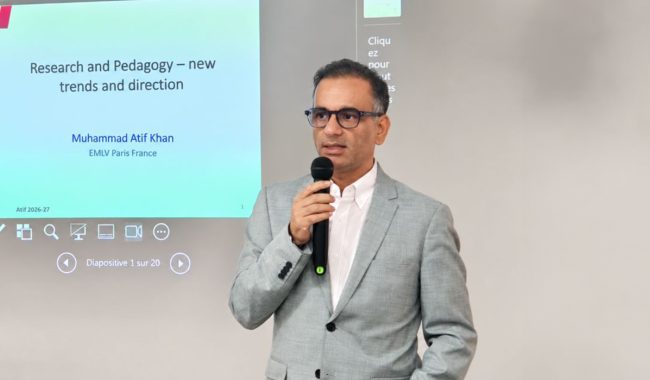
Muhammad Atif Khan, Associate Professor and Head of the International Business programme at EMLV, was invited by Thammasat University in Thailand to deliver a keynote at the inaugural “Research That Matters: Beyond Publication” conference. His presentation examined how research, teaching and industry can inform one another and contribute to changes in management practice.
The conference brought together researchers and students from Thailand, India, Pakistan, Myanmar, Indonesia and other countries to discuss the uses of academic knowledge beyond scholarly publications.
Bringing management research into the classroom
Muhammad Atif Khan’s presentation addressed a practical question for business schools: how can the knowledge produced by researchers support both student learning and professional decision-making?
He advocated incorporating faculty members’ intellectual contributions into their teaching. Research findings can provide material for classroom discussions, help students question established assumptions and introduce methods for analysing organisational problems.
As he explained:
“Our own intellectual contributions should become part of what we teach, allowing research to enter the classroom.”
This approach gives students access to the questions, evidence and reasoning behind academic findings. It also encourages them to examine how knowledge is developed and how its conclusions can be applied to different business contexts.
Action research and management practice
Another keynote theme concerned the relationship between researchers and organisations. Muhammad Atif Khan argued that research should help academics and practitioners understand and improve management practice.
He identified action research as a particularly useful approach. By engaging with professional situations, researchers can drive change while building knowledge through the process.
The emphasis is on interaction: management problems become subjects of investigation, while research findings can inform decisions and working methods. Questions raised by practitioners can also prompt researchers to reconsider their assumptions or examine issues that require further evidence.
For management education, this creates opportunities to connect theoretical concepts with the situations graduates will encounter in their careers.
A reciprocal relationship between research, teaching and industry
Muhammad Atif Khan described a cycle linking research, pedagogy and industry. Research informs teaching; teaching prepares students to engage with professional practice; questions arising from industry feed subsequent research.
Student needs and pedagogical challenges also contribute to this cycle. A difficulty encountered in the classroom can generate a research question, just as a problem reported by a company can guide an academic investigation.
His proposal therefore gives teachers, students and practitioners a place in shaping research agendas. The aim is to develop knowledge that responds to identifiable needs while retaining the analytical rigour expected of academic work.
International Business education at EMLV
These questions relate directly to EMLV’s approach to management education, which combines managerial knowledge, technological understanding and human skills. Research integrated into teaching helps students assess evidence and develop informed responses to business problems.
Within EMLV’s Grande École Programme, the International Business specialisation is taught entirely in English.
It combines personal and interpersonal development, managerial skills and professional experience, preparing students for management, business development and project responsibilities in international environments. Its teaching covers areas including international strategy, marketing, finance and global supply chains.
Further information about EMLV’s International Business specialisation.