

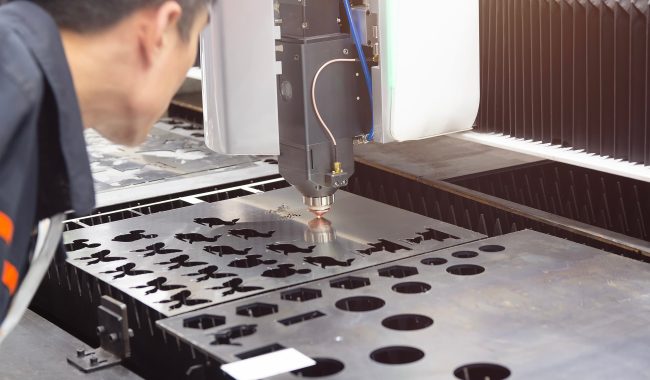
A cutting machine must do more than follow the outline of a part: it must choose where to begin, which cuts to make first and how to limit movement between them. In a contribution to FNEGE Médias, Daniil Khachai, Academic Director of MSc Supply Chain Management and Assistant Professor at EMLV, explains how mathematical optimisation can help plan those decisions.
The question applies to production in sectors ranging from aeronautics and automotive manufacturing to garments and semiconductors. Each setting brings different materials, part layouts and cutting constraints.
Why the order of cuts matters
A machine’s route affects how far its tool travels and how much time it spends moving between cuts. Planning that route becomes more complicated when one part sits inside another, several parts share a cut, or an area must stay attached until later in the process. Piercing thicker material can add another cost to the route.
These conditions affect the sequence and the distance travelled. A short route may be unusable if it cuts an outer boundary before the pieces inside it are ready. Production planners therefore need a method that accounts for the physical rules of the job while searching for an efficient path.
One framework for several cutting problems
Daniil Khachai’s research addresses what is known as the discrete Cutting Path Problem. Rather than treating each production setting as a separate mathematical problem, the researchers developed a general framework for translating different cutting requirements into a form that established optimisation methods can solve.
That form is the Precedence Constrained Generalised Travelling Salesman Problem. The name describes two central features: a route must be chosen among possible cutting actions, and some actions must happen before others. The precedence rules allow the model to represent practical requirements such as the order in which nested parts are cut.
The method starts with the cutting layout and its constraints. They convert these into a mathematical model to find an optimal or near-optimal route. The result is then translated back into a cutting path. According to Khachai’s account, the transformation preserves the cost of the original problem, so the mathematical solution can be evaluated against the production objective.
Testing the method on industrial cases
The researchers evaluated the framework through computational experiments using industrial instances. Their results show that the proposed methods can produce optimal or high-quality solutions within short computation times for many of the cases tested. The findings support using the framework as a basis for production planning tools.
For a production manager, the value lies in comparing routes while respecting a job’s constraints. Shorter movements and better sequencing can support decisions about machine time and production costs. The next research challenge is to improve performance when several cutting features occur together and to connect the methods more closely with industrial CAD/CAM systems.
Operations research and supply chain management at EMLV
Daniil Khachai’s work connects applied mathematics with decisions made on the factory floor. It also shows why operations managers need to understand both a model’s results and the production constraints behind them.
At EMLV, Daniil Khachai heads the MSc Supply Chain Management. The programme covers logistics optimisation, supply chain analysis and the use of digital tools in operations. His contribution to FNEGE Médias offers a specific research example: choosing a cutting route when machine movement, cutting order and material requirements all affect the decision.
Apply now (international applicants)
Learn more about the MSc Supply Chain Management
A lire ensuite :
 Dr Nazim Hussain Visited EMLV to Present his Research on Greenwashing and Bond Pricing
 Human resource management under sanctions and skilled labor exodus: an EMLV research at FNEGE Médias
 FNEGE Médias: Corporate Social Responsibility and Taxation, a Research by Safa Gaaya and Fathen Lakha
 Leading in the Digital Age: How Managers Spark Innovation a FNEGE Médias tribune by UL-AIN Noor