
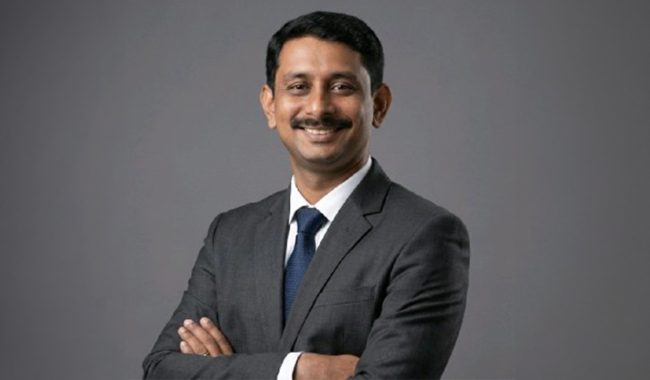
Alwin Tharakan, a class of 2026 MSc International Business student at EMLV, has successfully defended his thesis on resilience and risk management in global aerospace supply chains. Drawing on insights from more than 200 industry professionals, his research examines how aerospace companies can prepare for and respond to simultaneous geopolitical, logistical and material disruptions.
As part of his MSc International Business studies at EMLV, Alwin Tharakan, class of 2026, chose to explore a subject combining international business, risk management and industrial strategy.
Resilience & Risk Management in Global Aerospace Supply Chains
His thesis, entitled “Resilience & Risk Management in Global Aerospace Supply Chains,” focuses on a central question for the sector: how can global aerospace supply chains withstand and recover from geopolitical shocks, international sanctions, raw-material shortages and logistics disruptions when several of these events occur simultaneously?
The topic reflects the increasing complexity of an industry whose operations depend on extensive international networks. Aircraft manufacturers, maintenance organisations, equipment providers, specialised suppliers, and logistics companies must coordinate across multiple countries while complying with demanding technical and regulatory requirements.
Why aerospace supply chains are particularly exposed
The aerospace supply chain differs from those of many other industries because of its stringent certification processes, specialised components and long production cycles. Requirements such as the AS9100 quality-management standard, multi-year supplier qualification procedures and the limited availability of certain critical materials can make it difficult to replace a supplier at short notice.
Single-source dependencies represent another major risk. Titanium, for example, is essential to many aerospace applications because of its strength, resistance to corrosion and relatively low weight. When geopolitical tensions, sanctions, or transport constraints affect access to such a material, the consequences can ripple through the production chain.
In this context, recovery from disruption may take several quarters rather than a few weeks. A delay affecting one specialised supplier can ripple through Tier-1, Tier-2 and Tier-3 companies before ultimately reaching aircraft manufacturers, airlines or maintenance, repair and overhaul organisations.
Alwin’s research also highlights the limits of lean and just-in-time operating models. These approaches have supported efficiency and cost control across the industry for several decades. However, limited inventories and highly concentrated sourcing strategies can create vulnerabilities when several disruptions affect the supply chain at the same time.
Research informed by more than 200 industry professionals
To examine these challenges, Alwin drew on the perspectives of more than 200 professionals working across the aerospace, aviation and defence supply-chain ecosystem.
The participants represented aircraft and equipment manufacturers, maintenance, repair and overhaul organisations, Tier-1, Tier-2 and Tier-3 suppliers, and logistics partners. This broad range of profiles enabled the research to consider resilience from different positions within the value chain.
The study was conducted against a backdrop of continuing US–China tensions, International Traffic in Arms Regulations restrictions, post-Covid supply-chain fragility and rising demand for next-generation aircraft. These factors place additional pressure on organisations already managing long lead times, technical constraints and limited sourcing alternatives.
One of the thesis’s principal conclusions is that strategic redundancy should not be considered solely an additional cost. In sectors characterised by long supplier qualification cycles and critical dependencies, alternative suppliers, diversified sourcing, appropriate inventory levels and contingency planning can serve as safeguards for operational continuity.
Strategic redundancy therefore acts as a form of insurance: it may require investment, but it can reduce the operational and financial consequences of a major disruption.
Connecting international management with industrial realities
Through this thesis, Alwin applied several areas covered by the MSc International Business, including international strategy, cross-border operations and risk analysis, to a sector shaped by global interdependence.
His work shows how industrial and geopolitical realities shape international business decisions. Supplier selection, sourcing locations, regulatory compliance, and logistics planning cannot be evaluated solely on short-term cost efficiency. These decisions must also consider political risks, resource availability, supplier concentration, and the time needed to restore operations.
The research also underlines the importance of coordination between the different stakeholders involved in aerospace supply chains. Building resilience requires collaboration among manufacturers, suppliers, logistics providers, and public authorities, as well as greater visibility across the supply network.
Alwin completed this work under the supervision of Béchir Ben Lahouel, PhD, HDR, whose academic guidance and methodological rigour supported the thesis. Daniil Khachai also supported the research structure and progress throughout the semester.
The MSc International Business at EMLV
The MSc International Business at EMLV is a 12-month postgraduate programme designed to prepare students for careers in global business, international management and digital strategy.
Open to graduates from a range of academic backgrounds, the programme develops the skills required to manage international operations, support business development across markets and lead strategic projects in multicultural environments.
Students prepare for positions in areas including international business development, product management, digital marketing and corporate finance. Based in Paris–La Défense, the programme also places them close to the headquarters and offices of numerous French and international companies.
After successfully defending his thesis, Alwin plans to apply his research insights in his professional career. He is particularly interested in contributing to projects related to aerospace supply-chain resilience, risk management and strategic sourcing.
Learn more about the MSc International Business
A lire ensuite :
 Strategic Challenges and Opportunities for Indian Students in European Higher Education: A Master’s Thesis by Donas, EMLV class of 2025
 Academy of International Business Conference 2025: Sofia, class of 2024, Thesis on Luxury Storytelling Receives Conference Spotlight.
 AACSB 2025 State of Business Report: Rethinking Business Education in a Rapidly Changing World
 The Future of Work in Supply Chains: Lessons from the Pandemic and Beyond, by Salomée Ruel