
Within the MSc International Business at EMLV, masterclasses connect academic learning with leadership reflection and global economic analysis. Two sessions explored responsible leadership and the impact of megatrends on business strategy.
Integrated into the curriculum, these masterclasses create a direct link between theoretical frameworks and the realities shaping organisations today.
A learning format grounded in real-world expertise
The MSc International Business combines academic content with regular interventions from professionals. This framework enables students to engage with current business challenges through applied perspectives.
Each cohort attends two masterclasses designed to complement the programme. These sessions address leadership, strategy and global transformations through concrete cases and expert insights. This approach reflects the positioning of the Programme Grande École: preparing managers capable of understanding technological, economic and societal shifts.
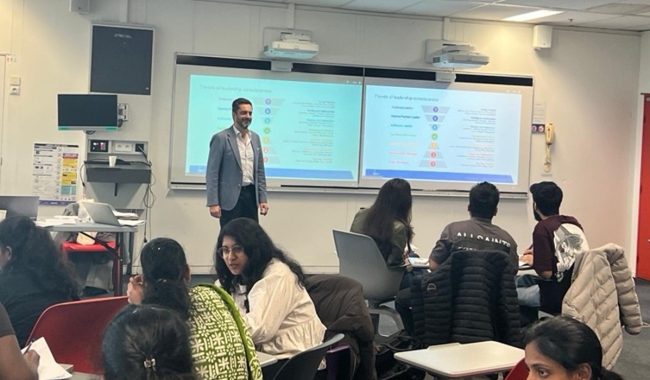
The first session was co-organised and led by Anthony Papon, Co-Founder of Laedx Digital Studio, alongside Céline Zimero, leadership consultant at Prana Conseil.
Responsible leadership: from self-awareness to meaningful impact
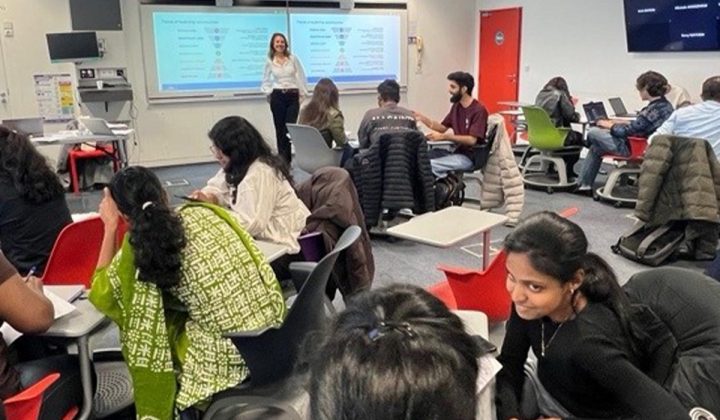
The first masterclass focused on responsible leadership. It combined practical experience with structured reflection, notably through the Barrett approach, which opened perspectives on individual values and leadership positioning.
The objective was twofold: to develop self-awareness as future managers and to reflect on the level of contribution each individual can bring as a leader. This framework also provided a basis to distinguish managerial roles from leadership responsibilities.
The discussion quickly moved beyond traditional questions of performance or career success. A central question structured the exchange:
What kind of leader does the world actually need today?
Students engaged with leadership as an internal process before it became a function. The session emphasised that responsible leadership begins with clarity: understanding one’s values, navigating complexity without simplification, and making conscious decisions rather than reacting to constraints.
Another key idea emerged:
Responsible leadership starts with an inner question: Who do I choose to be with the responsibility entrusted to me?
This perspective reflects a shift in expectations. While traditional management education focused on technical expertise such as finance or marketing, current environments require the ability to position oneself in uncertain and evolving contexts.
The exchange also highlighted the distinction between a manager and a leader: beyond coordination and execution, leadership involves intention, responsibility and the capacity to engage others around meaningful directions.
These dimensions align with the Programme Grande École’s emphasis on human skills and the development of reflective and adaptive managers.
Megatrends: understanding global transformations and their strategic impact
The second masterclass, “Megatrends: Searching for Growth in a Low-Growth World,” was conducted with Arnaud Tourlet from KMH.
This session extended the first by shifting from individual leadership to global dynamics shaping organisations. It focused on major transformations affecting the global economy, including ecology, geopolitics, energy and technological evolution.
The objective was to decode these megatrends and understand their current state and impact on company strategies. Students analysed how organisations identify growth opportunities in constrained environments and adapt to structural changes.
By linking macro-level dynamics with strategic decision-making, the session provided tools to interpret complex environments and anticipate their implications for international business.
MSc International Business: a programme with a format aligned with EMLV’s hybrid positioning
At EMLV, part of De Vinci Higher Education, the Master in Management — Programme Grande École is built on the interaction between management, engineering and digital disciplines. T
his hybrid approach translates into interdisciplinary projects, applied learning formats and strong connections with companies.
Masterclasses within the MSc International Business contribute to this model by connecting academic frameworks with professional practices. They bring together perspectives from consulting, strategy and innovation to support a comprehensive understanding of business environments.
Extending learning through dialogue and reflection
These masterclasses create opportunities for dialogue where students can question, analyse, and position themselves regarding future roles.
The combination of leadership reflection and global economic analysis reflects the programme’s objective: preparing managers capable of operating in international, complex and evolving contexts, while maintaining clarity in decision-making and responsibility in action.