
EMLV stands out in L’Étudiant’s 2025 rankings, coming fourth among post-baccalaureate business schools offering a Master in Management.
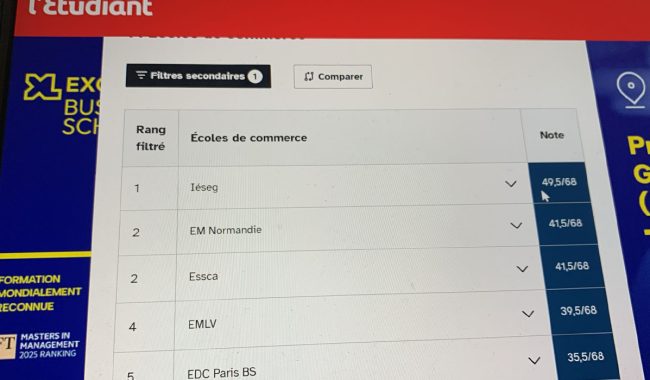
L’Étudiant has just published the 2025 edition of its rankings of top business schools for students entering directly after baccalaureate or after a preparatory year, which award a Master’s degree. As the top-ranked school in the SESAME entrance exam, EMLV is in 4th place in the post-baccalaureate rankings and performs strongly, remaining at the top of the 2025 rankings of top business schools across several criteria:
“The business school rankings published by L’Étudiant now include an indicator dedicated to the attractiveness and selectivity of institutions. This change aims to better reflect the dynamics of the schools, their ability to attract candidates and the rigour of their admission processes. To ensure consistency, the analysis distinguishes between post-baccalaureate programmes and those recruiting after preparatory classes, as their admission pathways differ. For the 2025 edition, data from Parcoursup 2023 and Sigem 2024 were examined on an institution-by-institution basis, cross-referencing several criteria: the number of ranked applicants, the acceptance rate for admission offers and the intake rate for each cohort. This approach allows for a more nuanced assessment of the recruitment dynamics specific to each market segment.”, L’Etudiant.
Post-A-level business schools in L’Etudiant’s rankings:
- 1 – IESEG
- 2 – EM Normandie
- 2 – Essca
- 4 – EMLV
- 5 – EDC Paris
- 6 – PSB, Paris
- 7 – Esdes
- 8 – ICD BS
- 9 – ESCE
- 10 – ISTEC
- 11 – EBS Paris
- 12 ISG
- 13 – Ipag
- 14 – Idrac BS
Key factors to consider when choosing a post-baccalaureate business school
For its 2025 rankings, L’Étudiant draws on around a hundred criteria, some of which are used for ranking purposes and others not. For this 2025 edition, the editorial team has used several indicators grouped into three categories: employment and career success, academic excellence, and international reach.
- Academic excellence: national and international accreditations, duration of the Master’s degree, visa duration, the school’s research strength…
- International outlook: minimum time spent abroad, proportion of students on academic exchange programmes, international faculty, multicultural exposure…
- Professional insertion: salaries four years after graduation, starting salaries, graduates employed abroad…
- Environment/CSR: DD&RS accreditation, awarded by the Ministry of Higher Education and Research; student societies dedicated to ecology and/or CSR; satisfaction with the school’s environmental commitment (CSR).
- Career prospects: proportion of students working in the banking, finance, insurance, audit, consultancy, retail and distribution, and digital sectors.
- School identity, social outreach, annual tuition fees in 2023, proportion of students receiving grants
- Professional development: proportion of work-study students, starting salary, proportion of permanent contracts
- Graduate satisfaction: satisfaction with international outreach, satisfaction with the alumni network, recommendation rate
New feature in the business school rankings: attractiveness and selectivity
Among the recent changes to the business school rankings published by L’Étudiant, the inclusion of an indicator focusing on attractiveness and selectivity represents a new area of analysis. The aim is to better reflect the dynamics of the institutions, their ability to attract applicants and the rigour of their recruitment processes.
To ensure a meaningful comparison, post-baccalaureate programmes and those recruiting students after preparatory classes have been analysed separately, given their distinct admission channels.
For the 2025 edition, data from Parcoursup 2023 and Sigem 2024 were examined on an institution-by-institution basis, looking in particular at the number of ranked applicants, the acceptance rate for admission offers and the intake levels of cohorts. This methodology allows for a more detailed assessment of the recruitment trends specific to each segment.
The post-baccalaureate ranking of business schools offering master’s degrees takes into account clearly defined criteria: student intake, academic excellence, international outlook, links with industry, social inclusion, graduate employment, and environmental commitment.
More than just rankings, these lists published by L’Étudiant are guidance tools designed for students, who can generate their own rankings based on their personal preferences.
To assist students in their search for business school programmes, EMLV organises several ‘Open Days’ sessions, allowing students to discover the school and its teaching staff.
This 2025 ranking of leading business schools awarding Master’s degrees can be found online on the L’Étudiant website (in French).