
As part of the second-year solidarity mission of the Master in Management – Grande École Programme, around ten EMLV students are committing to at least 70 hours of work with the Devinci Durable association. The urban vegetable garden project, whose harvests will be distributed to food insecurity associations in La Défense, is a learning opportunity that combines social responsibility, project management and teamwork.
This initiative illustrates how the PGE combines civic engagement, project-based learning and an understanding of environmental transitions.
A vegetable garden born out of a collaboration with Paris La Défense
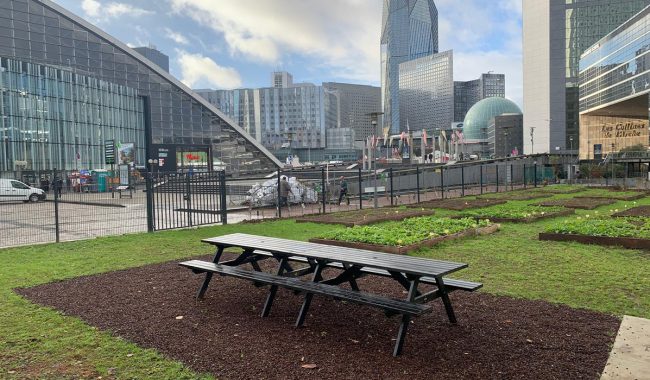
Originally conceived as a search for space in a shared garden, the project evolved thanks to the support of Paris La Défense, which offered a 600 m² plot of land.
This unique location makes it possible to create a green space in a largely mineral neighbourhood, while offering students a place for sustainable experimentation.
A solidarity project in line with the mission of the Grande École Programme
The solidarity mission is an integral part of the second year of the Grande Ecole Programme: one day a week is devoted to an organisation involved in the social and solidarity economy.
Devinci Durable is one of the partner associations and this year is hosting a group of EMLV students who are involved in the entire project cycle: laying out the vegetable garden, crop management, harvesting and distribution.
An educational approach based on crop diversity
Students participate in choosing crops that are suited to the seasons and designed to diversify species. The vegetable garden also includes an orchard.
The criteria selected are based on seasonality, educational value and interest in discovering lesser-known varieties.
A structured and progressive student commitment
EMLV students participate in all stages of the project. Their involvement includes:
- setting up the vegetable garden and maintaining the plots,
- managing compost and equipment,
- exchanges with partner associations in the neighbourhood,
- organising harvests and solidarity distributions.
This framework provides an opportunity to work on a comprehensive project and develop a commitment mindset, which is essential in training future managers.
Cultivation methods and awareness of sustainable practices
The vegetable garden is based on planters designed for urban spaces. Permaculture principles guide the choice of practices: diversity, plant combinations, respect for the soil, and limited inputs. Compost produced on site naturally enriches the crops.
The project develops at the intersection of three dimensions:
- educational, by offering a concrete learning support for the concepts of urban agriculture and collective management;
- social, through the distribution of harvests to local food insecurity associations;
- community, by making the vegetable garden a place for meeting and cooperation between students in the neighbourhood.
Learning and skills developed
Students strengthen cross-disciplinary skills: planning, coordination, teamwork, partner relations and understanding of natural cycles.
The vegetable garden also serves as a platform for technical or creative projects, such as 3D modelling or awareness-raising workshops.
The association plans to expand its partnerships and set up workshops open to the public, particularly on the topic of urban biodiversity. The development of the vegetable garden will depend on the commitment of participants, the vitality of the crops and the impact of solidarity actions related to the harvests.