

Invited to the 19th edition of the Design Theory Paris Workshop, Diórgenes Mamédio, professor and researcher at EMLV, presented his work on the integrative model of engineering and management research through the lens of engineering design and strategic improvisation.
His contribution addressed how organisations respond to uncertainty by combining structured design processes with adaptive managerial practices.
A research contribution within the European Academy of Management
The presentation took place within the Design Theory Special Interest Group (SIG), whose primary objective is to support and structure research that contributes to the renewal of design theory. The SIG advances this work by drawing on recent scientific advances and addressing highly innovative design challenges. Its research agenda is organised around a dual logic that combines a formal approach to design theory with a more open perspective that connects design theory with broader fields such as management, economics, art, and philosophy.
This interaction enables both the application of formal models to new contexts and the emergence of new theoretical questions, structured around four main axes: formalised models and mathematics, flexible structures of knowledge, theory-driven experiments, and the historical and contemporary foundations of design theories.
Diórgenes Mamédio, Associate Professor at EMLV and researcher within De Vinci Higher Education, was invited to take part in the Design Theory workshop.
His presentation was delivered during a parallel session on management and design theory, alongside Professor Albrecht Fritzsche of IEDC. The invitation followed academic exchanges around shared research interests, highlighting converging perspectives between management and engineering research communities.
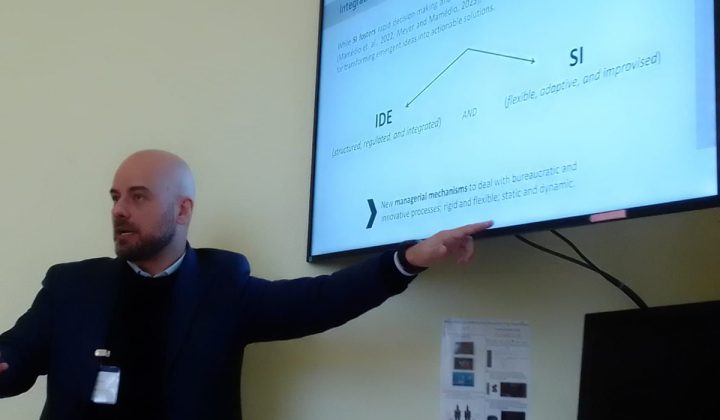
Diórgenes Mamédio, Associate Professor at EMLV and researcher during his presentation
Design theory as a bridge between engineering and management
The conference focused on design theory, understood as a framework for analysing how organisations conceive, structure, and transform ideas into actionable solutions. In this context, Professor Mamédio explored how design processes foster dialogue between engineering logic and managerial decision-making.
Engineering design traditionally relies on structured methods, standards, and reliability. Management, by contrast, often operates in environments shaped by uncertainty, ambiguity, and non-linear change. The research presented examined how design theory enables these two perspectives to interact rather than to oppose one another.
This approach reflects a broader research interest in organisational systems that require both stability and adaptability, particularly in sectors characterised by technological complexity and rapid environmental change.
Strategic improvisation as a managerial practice
At the core of the presentation was the concept of strategic improvisation. Rather than viewing improvisation as a reaction to disorder, the research positions it as a deliberate managerial practice.
Strategic improvisation refers to the capacity of organisations to integrate existing structures with real-time adaptation in response to unforeseen situations. It mobilises experimentation, interaction, sensemaking, and problem resolvability to support decision-making in contexts where linear planning proves insufficient.
The presentation argued that integrating strategic improvisation with engineering design strengthens organisational responsiveness, especially in loosely coupled systems such as healthcare networks, supply chains, project-based organisations, or innovation ecosystems.
An integrated model for organisational responsiveness
The research proposed a conceptual model that combines integrated engineering design with strategic improvisation. This model suggests that responsiveness emerges through the interaction between structured design mechanisms and adaptive managerial behaviours.
By aligning human-centric design principles, interdisciplinary knowledge, and improvisational capabilities, organisations can address uncertainty without abandoning reliability or coherence. This perspective contributes to ongoing debates on how organisations balance rigidity and flexibility in complex environments.
The work also highlighted the practical implications of this integration for managers who operate across technical, strategic, and organisational boundaries.
Transversal research aligned with EMLV’s academic positioning
This contribution reflects the transversal academic environment fostered within the De Vinci Higher Education, where management, engineering, and digital disciplines interact daily. At EMLV, this hybrid approach informs both research and teaching practices.
While strategic improvisation is not taught as a standalone topic, its underlying principles are taught through examples, case discussions, and corporate strategy courses that connect managerial theory to real organisational contexts.
The research presented at EURAM illustrates how academic work conducted at EMLV contributes to international scholarly debates while remaining connected to the realities faced by organisations.